
Oval vs Marquise Engagement Rings
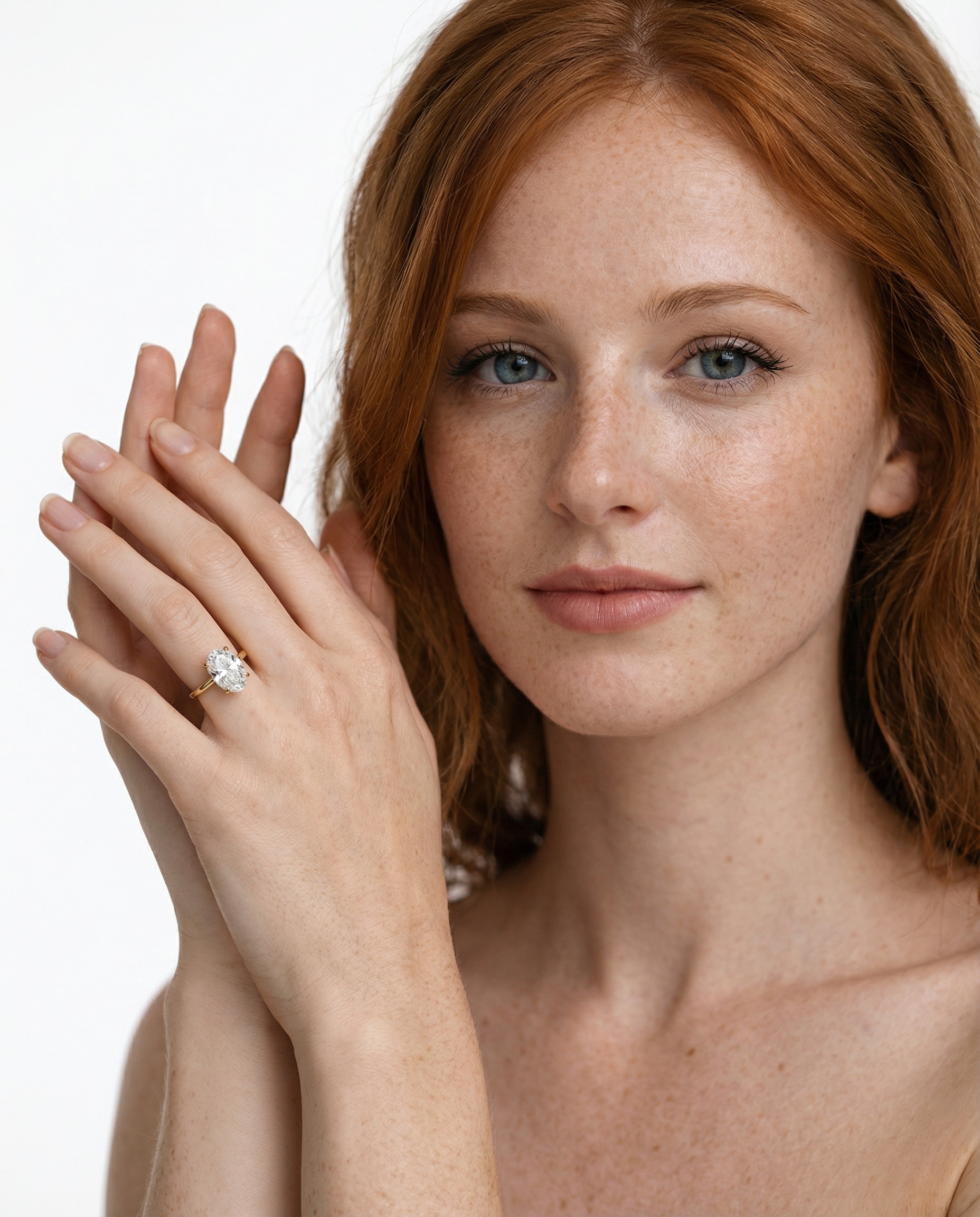
You know you want an elongated diamond, but the shortlist keeps switching between oval and marquise rings. An oval has rounded ends; a marquise curves towards a point at each end. That difference gives you a useful place to begin, before comparing prices or getting lost in diamond grades.
Within each shape, there are fuller and narrower outlines to explore. The setting adds another choice: how much of the edge you want to see.
Work out whether you like the points or the frame
Start with relatively simple designs so you can follow the centre stone’s edge. A halo of smaller diamonds or a substantial metal border adds another outline, which may be the feature attracting you in the first place.
Lily Arkwright’s collection of marquise shapes and settings includes lab-grown diamond solitaires with either claws or a full bezel, a continuous metal rim. Keep the metal colour, stone dimensions and orientation similar when comparing them, so you can see what the framing changes.
The difference is easy to overlook in a saved photograph. You might love a marquise surrounded by yellow gold, then find a claw-set example less appealing. That is useful information: the gold border belongs in your description of the ring you want.
Compare more than one version of each shape
A fuller marquise and a very slender oval can challenge your first impression of the two categories. The marquise still has points, but its curved sides may give it more fullness through the middle. A narrow oval can look long and slender despite its rounded ends.
GIA’s research on fancy-shaped diamonds explains that the curves and point angles vary beyond the length-to-width ratio. A ratio helps describe how long a stone is relative to its width; it cannot describe every part of the outline.
Give the oval its own comparison: put a fuller example beside a narrower one in similarly simple settings. Follow the curve around each end and into the sides. Notice whether you prefer a generous curve through the middle or a slimmer outline. For the marquise, try a fuller example if the first feels too narrow.
Record length and width in millimetres as well as carat weight. Weight alone does not establish how much space the centre will occupy. Keep the complete setting’s dimensions in mind too, especially if a border contributes much of the ring’s presence.
Give the marquise’s tips some attention
The pointed ends make a marquise distinctive, but they also need protection. GIA’s marquise guide identifies the tips as vulnerable to chipping and explains how V-shaped claws or a bezel can help protect them.
Ask the jeweller to show you how both points are secured in the particular ring. Then look at what the metal does to the design. V-shaped claws echo the pointed ends, while a full bezel carries a continuous line around the stone. The amount of visible metal is part of the choice.
An oval avoids those two pointed tips, although it still needs a suitable, secure setting. Choosing rounded ends does not remove the need to discuss construction and care.
Look at the diamond in motion
Once you like an outline, give the diamond itself some attention. Both shapes can show a bow-tie-shaped pattern across the centre that looks dark from some viewing positions. Its prominence varies with the stone and lighting.
Watch the actual shortlisted diamonds tilt slowly in different lighting, in person or on video. Notice whether the centre becomes lively as it moves or whether a broad dark area keeps distracting you. Turning down a particular stone does not mean you have chosen the wrong shape.
Leave with a preference you can describe
If you plan to add a wedding band, try the intended combination before ordering. Check the space around the centre setting and how the two rings feel together. Notice how the wedding band changes the overall outline of the pair.
Before making a final choice, finish this sentence: “I prefer this one because…” Be specific. Perhaps it is the oval’s rounded ends, the marquise’s two points, or the yellow-gold rim around a fuller centre.